








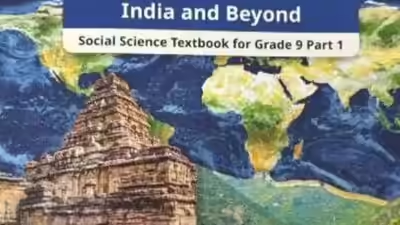
The National Council of Educational Research and Training (NCERT) has included a poem from ‘Manu-smriti’ in its newly launched class 9 social science textbook to explain that women were respected during the Vedic period. Manusmriti has been controversial over the years. Many critics say it justifies social inequality, while others defend it as part of India’s civilizational heritage and say its teachings are often misunderstood.In the NCERT book, in the chapter “State and Society before 1000 AD”, the textbook says that the Vedic period “is often described as a period when women occupied a high and respected position in society”.The textbook adds that the tradition of respecting women continued in texts written after the Vedic period. It then quotes Manu-smriti 3.56, which says: “When women are indeed respected, the gods rejoice; however, when they are not respected, all sacred rituals are fruitless.”Shortly after quoting this verse, the textbook says that the status of women has changed over time. The report states, “Over time, as social and political conditions changed, women’s status and roles fluctuated or even declined. However, there are many examples of women continuing to contribute to household management, agriculture, crafts, and religious activities.”Later examples are also given in this chapter. The report says that literature from the Gupta-Vakataka period describes women who were educated and proficient in the arts and mentions queens who played important roles in governance and religious patronage. It also emphasizes the mention in Sangam literature of women as active participants in society and the economy.The textbook also revisits the concepts of varna and jati. It says that early Vedic societies did not allocate social status solely on the basis of birth. According to the book, social identity is shaped by a variety of factors, including race, region, language, occupation, and cultural relationships.It further explains that these four varnas came to be associated with specific roles, but were initially considered functional categories rather than strict divisions. According to textbooks, the jati system later developed through intermarriage, endogamy and territorial differences between communities. It added that while the number of varnas remained fixed at four, there was no limit on the number of jati, which continued to increase with the emergence of new professions and social groups.