





New Delhi: In December of last year, with 2026 FIFA World Cup in the United States, Mexico and Canada six months apart, FIFA announced hydration breaks in both halves of the game. Similar breaks were introduced in 2014 and then selectively taken four years ago in Qatar where the temperature reached 30 degrees Celsius.“For every game, it doesn’t matter where the games are played, it doesn’t matter if there is a roof, (or) in temperature, there will be a three-minute hydration break. It will be three minutes from whistle to whistle in both halves,” said Manolo Zubiria, Chief Tournament Officer, USA, for the 2026 FIFA World Cup. As it was made clear by FIFA, the breaks had to be taken whether the outside temperature was 15 degrees or 35-40 degrees Celsius. After the first 24 matches, two matches were categorized with “severe heat” according to the wet bulb index: Saudi Arabia vs. Uruguay (in Miami) and Sweden vs. Tunisia (in Monterrey). Other matches that witnessed searing heat were: Germany vs. Curacao (in Houston), Portugal vs. Congo (in Houston), Netherlands vs. Japan (in Dallas) and England vs. Croatia (in Dallas).Now the referees immediately stop the game at the 22nd minute of both halves regardless of the weather, the type of stadium (roofed or not), the conditions. The referee blows the whistle and the players head to the touchline for water.While ostensibly introduced as a player welfare measure, the holes are obvious and the field is divided. USA coach Mauricio Pochettino said: “I don’t like it. I only like it when the conditions are extreme. But when the conditions are good, it’s not necessary.”England manager Thomas Tuchel isn’t a fan either. “I think it interrupts and changes the identity of a football game a lot more than I thought. I had hydration breaks before when it was really, really hot and needed, but they were shorter,” said Tuchel.“They were shorter and they were only in a few games. In the interests of fairness here, it is now done in every game for every team. It breaks the game almost in four quarters. And I think it changes the characteristic of the game more than I thought.”
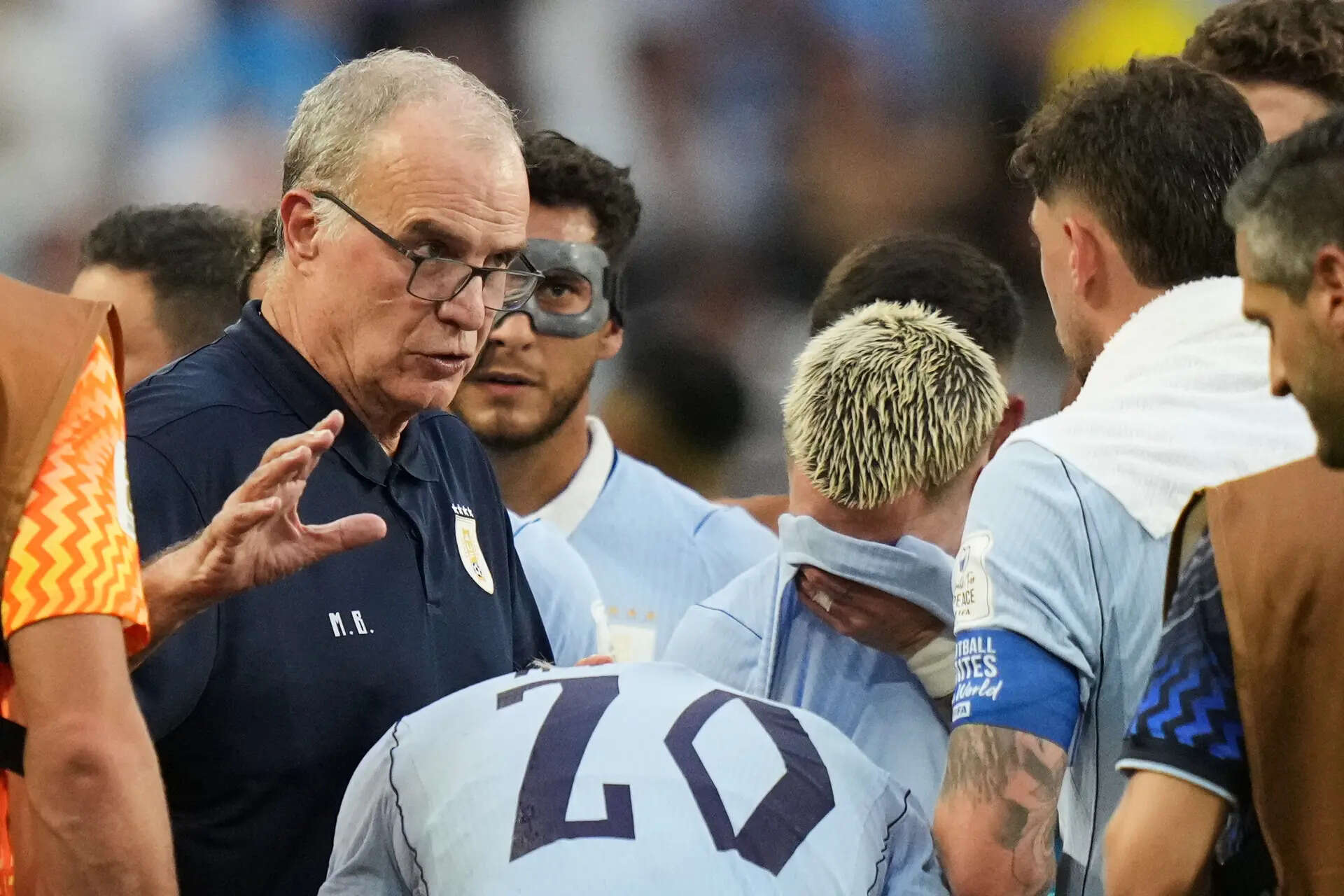
Uruguay coach Marcelo Bielsa talks to his players during a hydration break in a World Cup Group H match against Saudi Arabia in Miami Gardens, Florida. (AP)
Uruguay’s Marcelo Bielsa echoed Tuchel’s thoughts on the game being broken. “This culture change adds nothing and takes away a lot. I will just say that before this decision, football had one characteristic, now it has another,” said Bielsa.“As a player, he can work both ways,” said Belgian Youri Tielemans. “In some cities, it’s not so hot and maybe we shouldn’t do it. But at the end of the day, if you do it in some cities, you have to do it for everyone.”
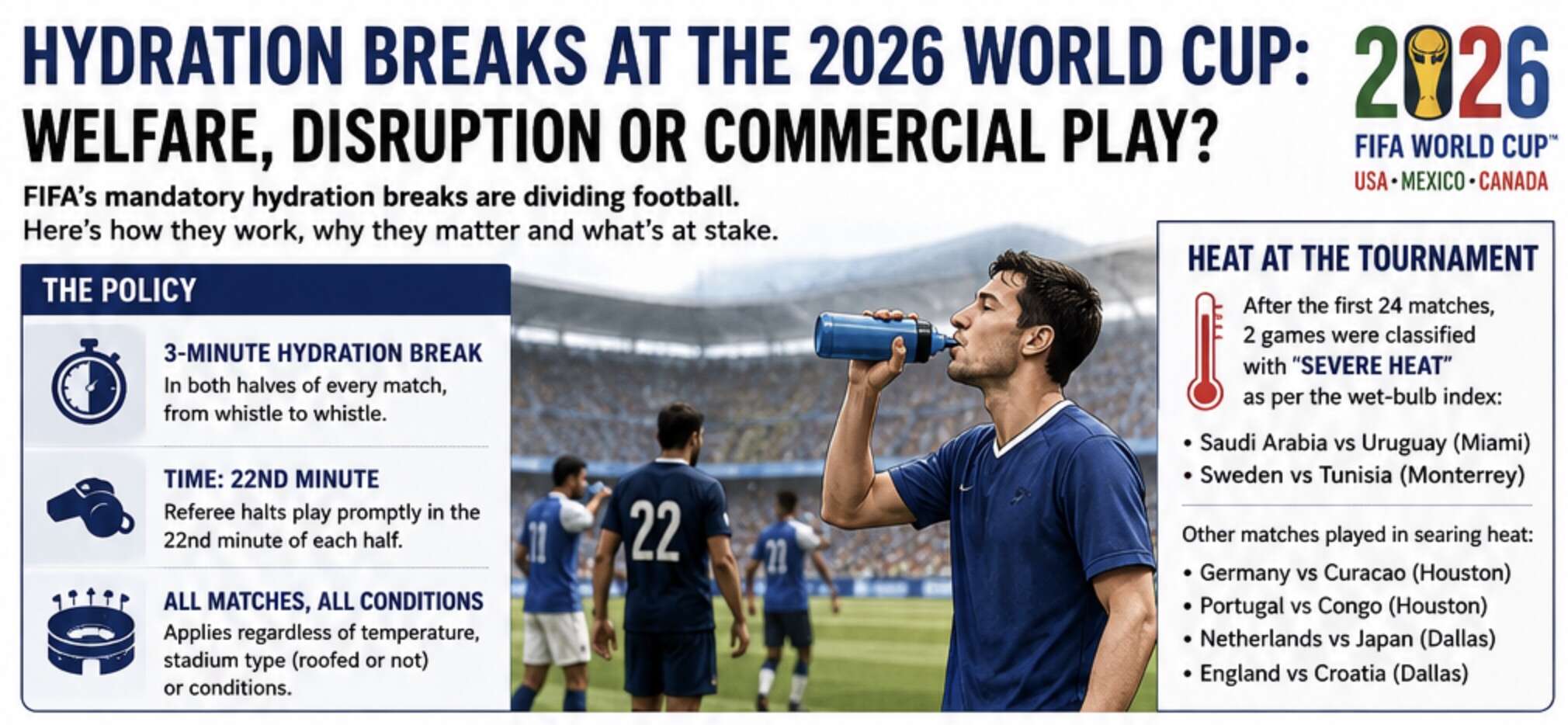
An illustration of the hydration breaks being followed in all the matches of the FIFA World Cup 2026. (Illustration by TimesofIndia.com)
French striker Kylian Mbappe remains neutral. “The hydration breaks? Don’t ask us players for our opinion, we are very reactionary,” he said. “If tomorrow we dominate in the 25th minute and there is a hydration break, we will be upset.”“Because it breaks our rhythm, but if the weather is hot, or we are dominated, I will be happy.”Paraguay coach Gustavo Alfaro has hit out at FIFA for the commercial intrusion that is the hydration break.“It’s a commercial break, not a hydration break,” he said. “The game is getting out of hand.”7 hours, 30 minutes, 40 seconds more commercial time
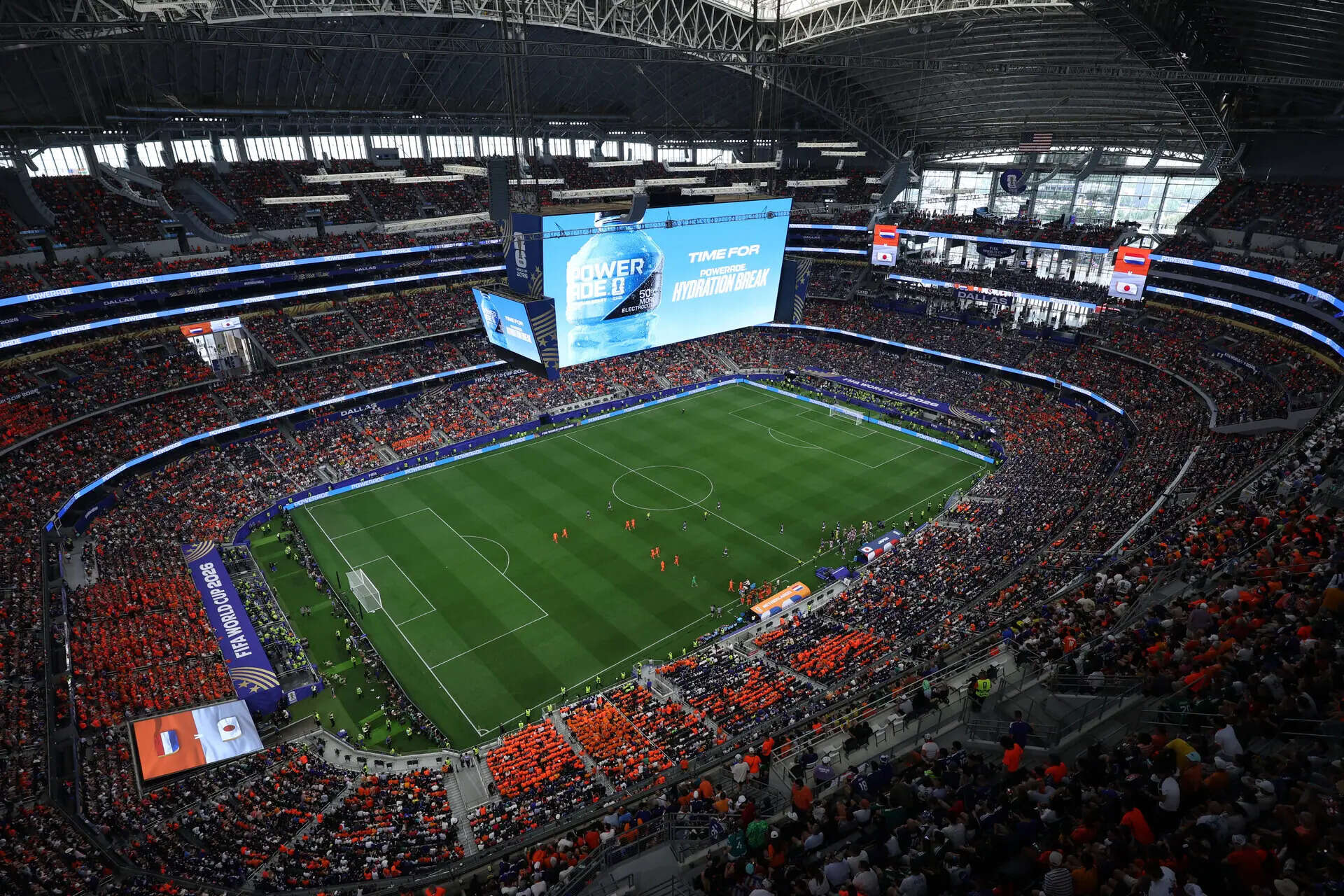
Sign for a hydration break is displayed during the World Cup Group F match between the Netherlands and Japan in Arlington, Texas. (AP)
During hydration breaks, broadcasters are allowed to cut the announcements 20 seconds after the referee blows the whistle and must return 30 seconds before restarting.That’s an advertising opportunity of four minutes and 20 seconds per match or seven hours, 30 minutes and 40 seconds across the entire 104-game tournament.Fox Corporation, which reportedly paid nearly $500 million to broadcast the World Cup in the United States, violated those guidelines during the tournament openers with Mexico and South Africa.

How hydration breaks are more than a measure of player well-being. (Illustration from TimesofIndia.com/NotebookLM)
Fox skipped its commercials for 40 seconds and failed to return to live footage when the game started. However, the broadcaster avoided a fine.The US alone could account for more than $250 million (Rs 2367.91 crore) in ad revenue during hydration breaks. Globally, it could reach a billion dollars, experts say.
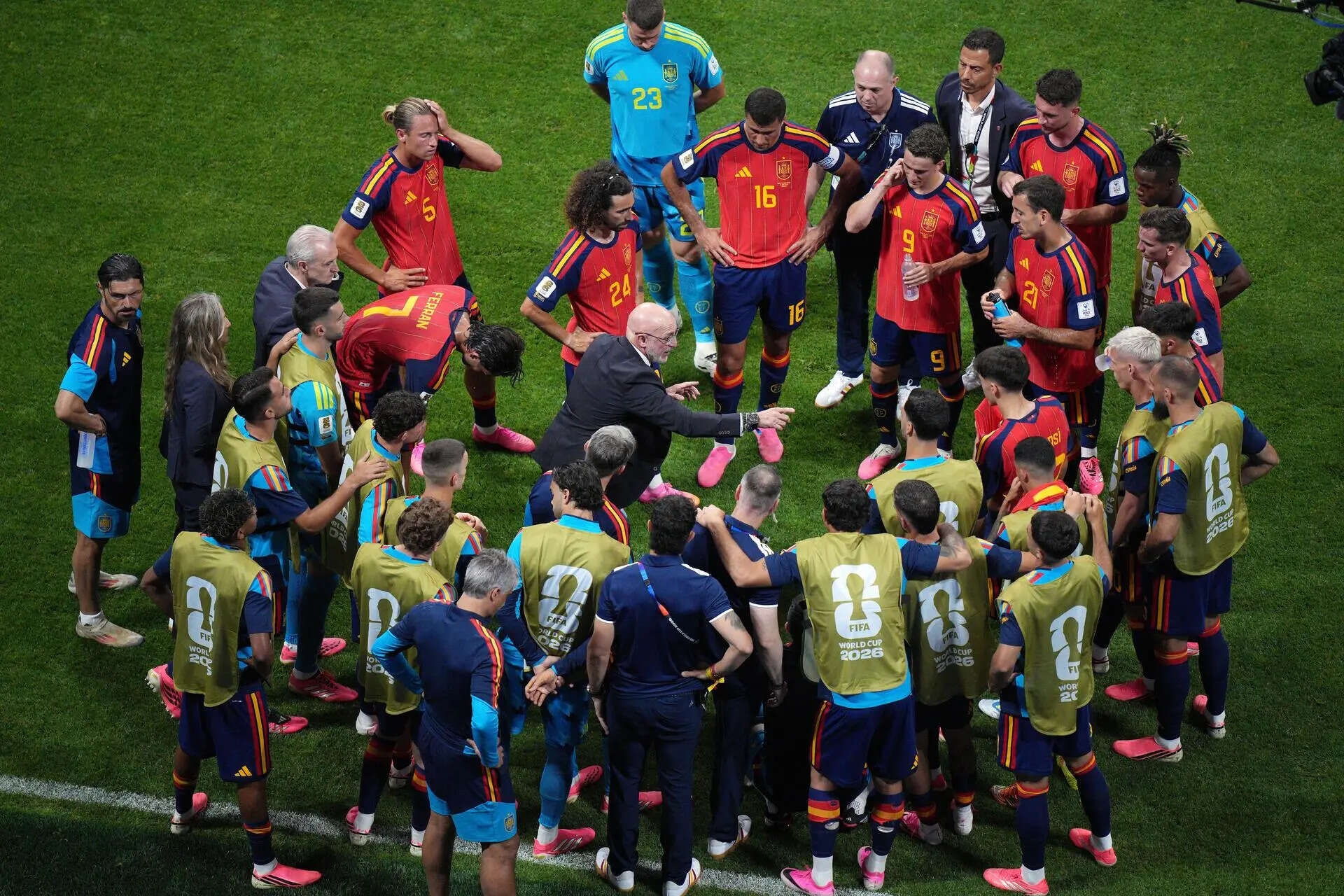
Spain coach Luis de la Fuente talks to players during a hydration break in the World Cup Group H match between Spain and Cape Verde in Atlanta. (AP)
In India, the ad inventory for a 10-second spot on Zee, the official broadcaster, is reported to be Rs 2.25 lakh to Rs 2.75 lakh. There are slots for pre-game, post-game, half-time and even those hydration breaks.BBC Sport reported that a 30-second ad spot on Fox Sports costs between $200,000 (Rs 1.89 crore) and $300,000 (Rs 2.84 crore). It can go up to $750,000 (Rs 7.10 crore) during the USA matches and the final stages.Ads are shown around the world during these hydration breaks. India, Mexico, Canada, France, Germany, Italy, Spain, China, Japan, Australia, the Gulf countries and sub-Saharan Africa, all saw advertising.
The United States alone could account for more than $250 million in advertising revenue during hydration breaks. Worldwide, it could reach a billion dollars
Experts
Some broadcasters have opted to return to advertising. The BBC in the UK does not show commercials; Spanish-language broadcaster Telemundo and the UK’s ITV have also opted to go commercial. However, ITV are also limited by the national regulator.Fox Sports has also experimented with its approach. During the Mexico vs. South Korea game, the broadcaster used a split screen of live stadium footage and commercials. Elsewhere, they also showed full-screen ads.Managers use breaks to change strategy
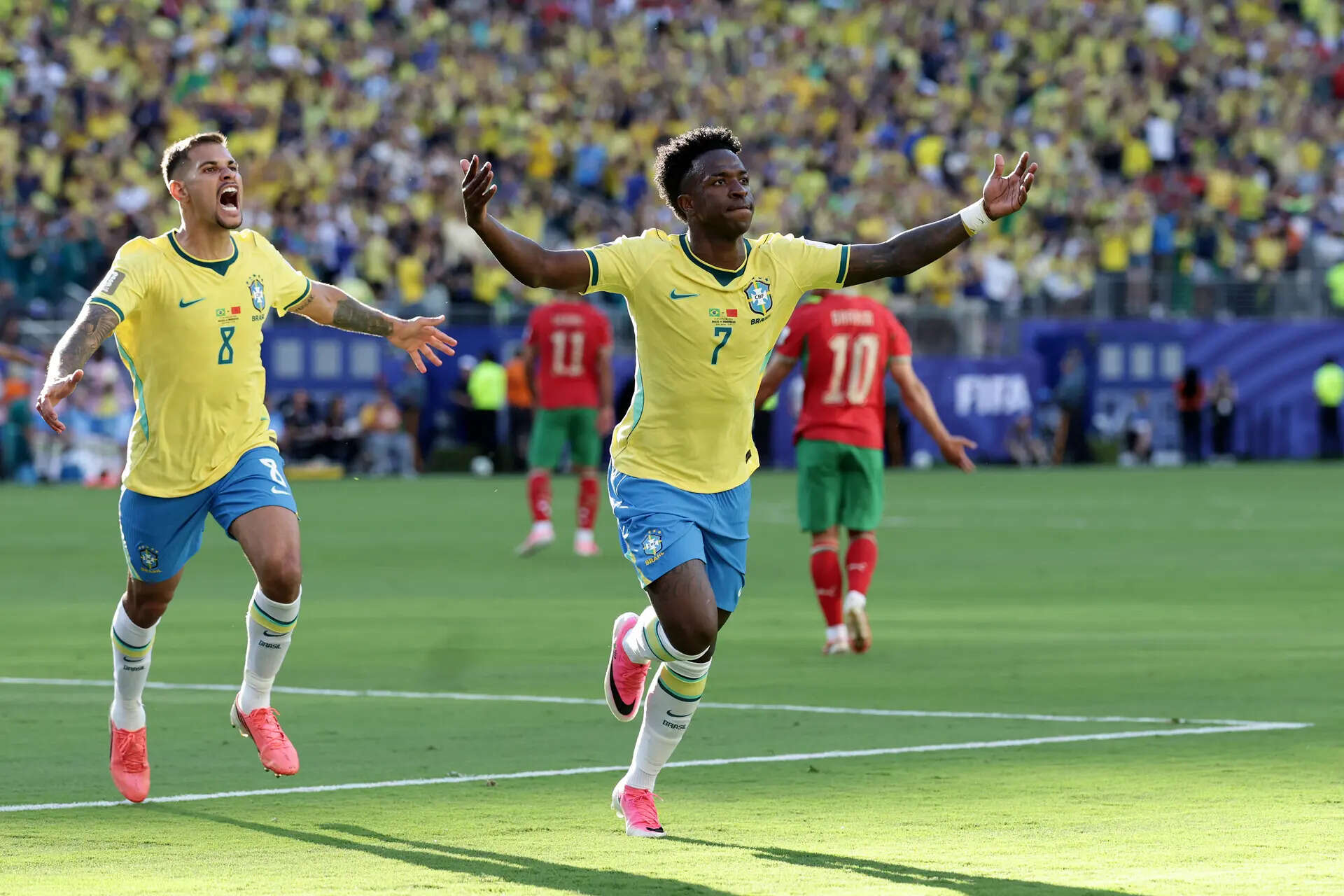
Brazil’s Vinicius Junior (7) celebrates a goal against Morocco. (AP Photo)
Brazil trailed Morocco 1-0 after a poor start. Six minutes after the hydration break, Vinicius Jr. he cut to the right foot and curled the ball into the roof of the net. Individual brilliance, no doubt, but manager Carlo Ancelotti later acknowledged that the hydration break allowed him to change his path.“You can explain a problem to the players,” said the Italian manager when asked how breaks can benefit a team. “[You can] make a tactical adjustment that can be very good.”Not just Brazil. Canada called Bosnia and Herzegovina’s lead shortly after the break in a 1-1 draw. Scotland scored shortly after the break in a 1-0 win over Haiti. Australia opened the scoring just after the break in a 2-0 win against Turkey.
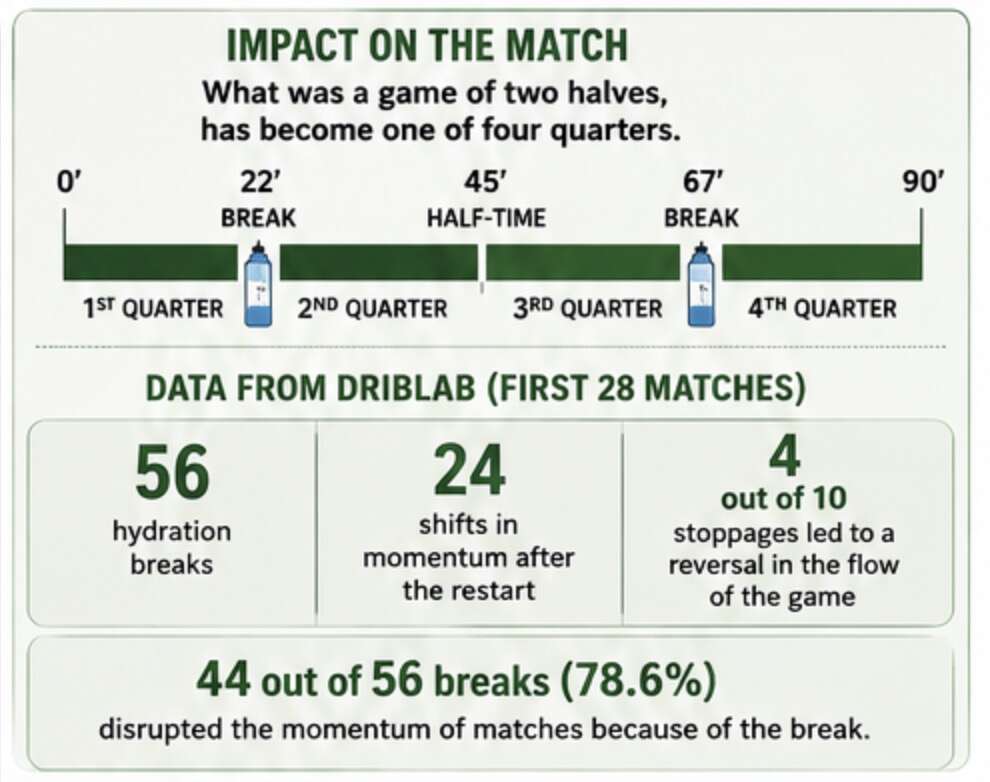
Games are affected at the 2026 World Cup due to hydration breaks. (Illustration by TimesofIndia.com)
Unlike conventional half-time breaks, managers can use hydration breaks to regroup and change strategy. What was a game of two halves, became one of four quarters.According to the statistics firm Driblab, in the first 28 games, or 56 breaks, 24 changes in momentum were recorded after the restart. Four of 10 stoppages led to a reversal in the flow of a game. And in another 20 breaks, the team that was dominating – like England against Croatia – started to falter after the first break. Spain, who were heroically kept in a stalemate by Cape Verde, were also pegged back after the second break.In all, 44 of the 56 breaks after the 28 games – or 78.6% of the cases – disrupted the momentum of the games because of the break.
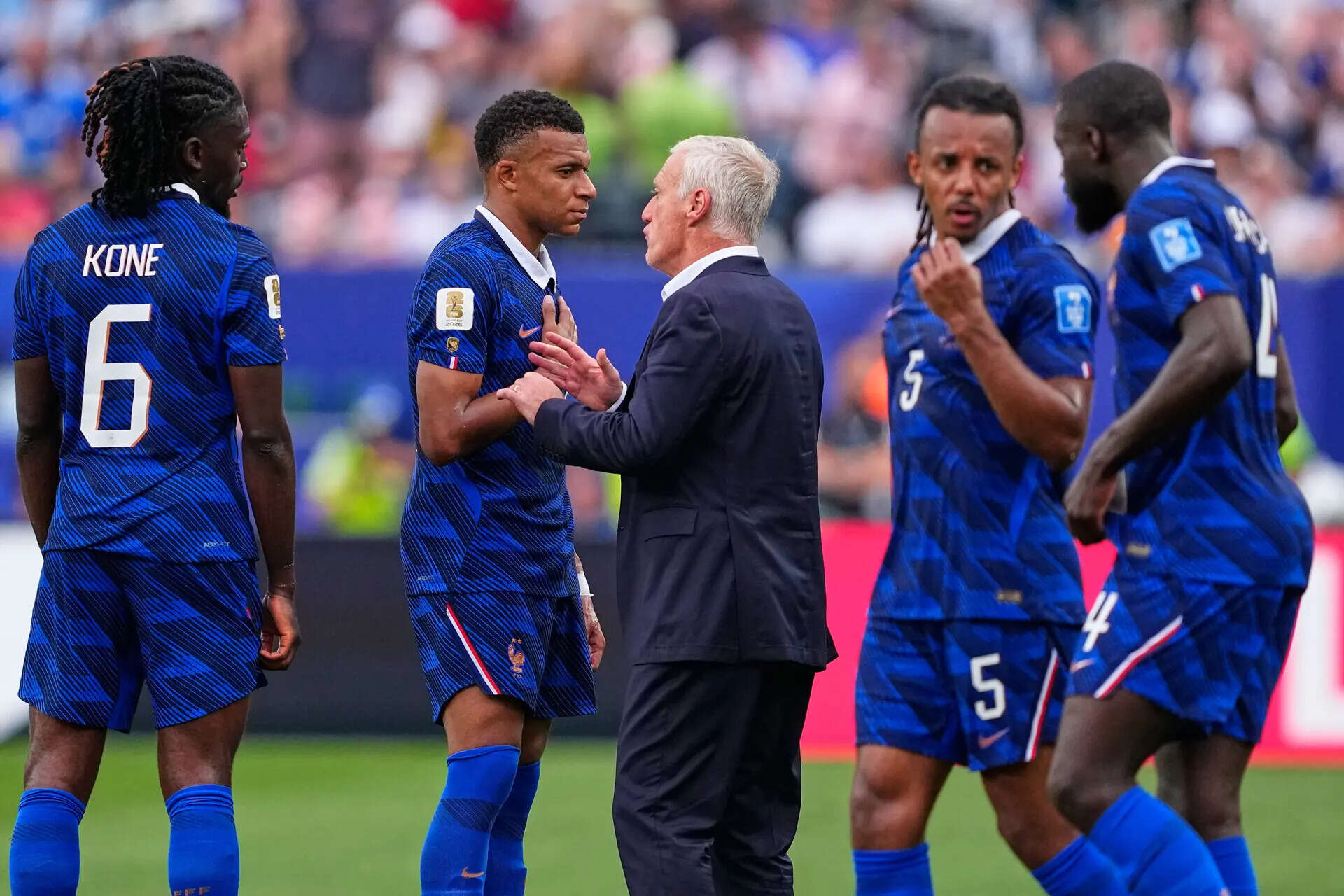
France coach Didier Deschamps talks with Kylian Mbappe (10) in the hydration break during the World Cup match against Iraq in Philadelphia. (AP)
India defender Sandesh Jhingan, who plays for FC Goa in the Indian Super League, suggested that it should be applied according to the conditions and even then tactical changes should not be discussed.“There needs to be some rule that only if the temperature is so high, then we will have a break but a shorter break. And then the players are not allowed to go out to clear and the tactics board comes out. It should not be allowed,” Jhingan, who is an expert on Zee5, told TimesofIndia.com.“Maybe just having a trolley of water coming in quickly, like five yards down the field, shouldn’t be allowed to leave the touchline.So they all stand to one side. Just water in, quick sip, boom, go. I think that would be the way forward.”He also argued that three minutes was a long period for the game to be disrupted.“Three minutes in the world of football is a long time. It is literally 7 to 8 attacks can happen in three minutes.“Why we love this sport is because when you are tired, when you are exhausted, your brain is more tired. Your heart rate is at 170-180. The game opens because you make some wrong decisions. And this is what excites people. Now take that.“After 22-23 minutes you have a break of three minutes. You can prepare again. Move the tactic. And again start playing. Then continue to cancel each other.”