








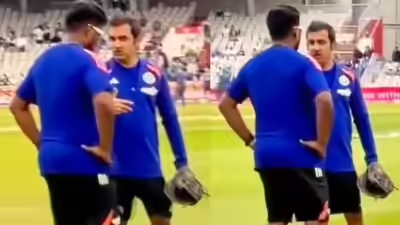
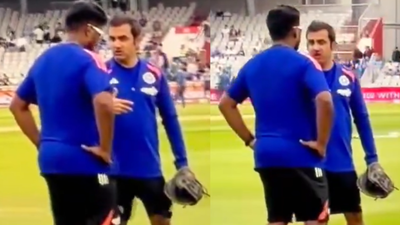
Vaibhav Sooryavanshi’s long-awaited India debut finally became a reality at Old Trafford on Saturday, but one of the most impressive moments ahead of the second T20I against England had little to do with the sensation of the teenager getting his cap. Soon after the announcement of India’s playing XI, the television cameras focused on the head coach Gautam Gambhir share a quiet conversation with Saint Samson on the outfield. There was no audio from the exchange, and any attempt to interpret the discussion would be speculative. Still, the visuals carried their own meaning. Samson’s omission was not that of a player who had simply fallen out of favor overnight. He had been one of the cricketers that Gambhir consistently championed during India’s triumphant T20 World Cup campaign, when the wicketkeeper-batter played a decisive role in lifting the trophy. Earlier this year, Gambhir had gone out of his way to praise Samson after one of his tournament-winning performances, describing him as a “world-class player” and saying the innings reflected the team’s commitment to supporting him. It also brought out Samson’s immense talent, composure and the faith that management had always placed in his ability. Those remarks made Saturday’s images even more poignant. The same coach who had repeatedly backed Samson now had to drop him as India chose to give Sooryavanshi his first international appearance. The decision is particularly notable considering Samson’s contribution to India’s World Cup triumph. He was named Player of the Tournament after producing three decisive innings, performances that proved instrumental in India’s title-winning campaign. Many would say that India would not have lifted the trophy without those shots. However, after scores of just 5, 0 and 1 during the ongoing UK tour, his position has come under intense scrutiny. The selection dilemma was made tougher because Ishan Kishan retained the wicketkeeping gloves, leaving Samson to compete only as a premier specialist batsman. India had tried to resist calls for immediate change. On the eve of the match, the coaching staff talked about rewarding the players who delivered on the biggest stage, with Samson’s World Cup contributions forming a key part of that argument. The message suggested that the management was determined not to take a knee-jerk decision despite growing demands for Sooryavanshi’s inclusion. However, when the toss was made in Manchester, the management had decided to move in a new direction. Sooryavanshi was given his India captaincy and became the youngest player ever to represent the country, surpassing the long-standing record held by Sachin Tendulkar. For the teenage prodigy, it marked the beginning of what many hope will be a remarkable international career. For Samson, however, it served as another reminder of how quickly fortunes can change in international cricket. A few months after being the Player of the Tournament in India’s World Cup campaign, three low scores were enough to cost him his place in the side. The brief chat with Gambhir before playing perhaps summed up that reality better than words.