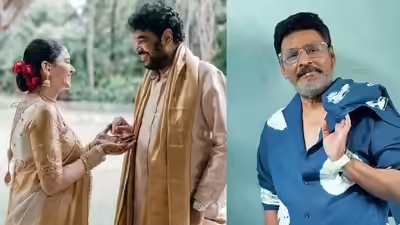




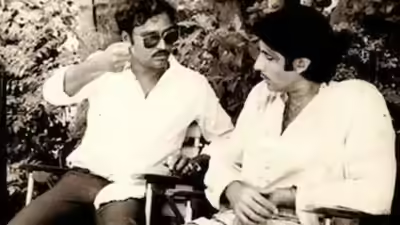
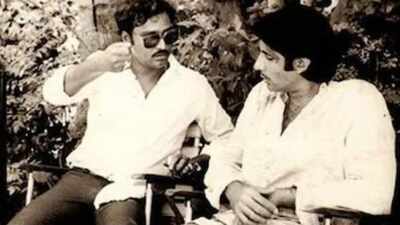
The Indian film industry has lost one of its most celebrated auteur directors on Saturday, June 27 as veteran cinematographer K Bhagyaraj passed away. Bhagyaraj, who is known for his unique, well-known stories and his humor and imagination, left behind a legacy that spanned many years and several languages. Although he is considered a giant of Tamil cinema, his work also touched Hindi films, most notably through ‘Aakhree Raasta’ (1986), which paired him with. Amitabh Bachchan.By the time filmmaker A Purnachandra Rao, also known as Poorna Chandra, approached Bhagyaraj to direct a Hindi film in the mid-1980s, the filmmaker’s stories had already become popular among Hindi audiences through his Tamil films. However, this time Rao wanted Bhagyaraj in the director’s seat. The filmmaker was initially skeptical, as Hindi cinema at the time was dominated by action films, while he made his name in family dramas and light comedies. Despite his doubts, Rao persisted, and eventually convinced Bhagyaraj to tell the story.The story was previously made into Tamil as ‘Oru Kaithiyin Diary’ (1984), directed by and starring Bharathiraja. Kamal Haasan in two works. Rao felt that Amitabh Bachchan was leading a revolution in Hindi and arranged for the actor to hear the voice in Chennai. Although Amitabh liked the story, he is said to have doubted whether Bhagyaraj, who had never directed a big film before, could handle such a big project. Bhagyaraj later recalled that Poorna Chandra had defended him, and told Amitabh that since the story was created by Bhagyaraj, he knew exactly what to do.The film eventually became ‘Aakhree Raasta’, which was released in 1986 under Lakshmi Productions. According to Bhagyaraj, Amitabh tested him on the first day of shooting. Although he had a complete script, the actor asked the director to explain how another scene would be filmed. Bhagyaraj believed that it was a test of his preparation. Before finishing his explanation, Amitabh is said to have smiled and said: “I understand. I think I can do it now,” leaving Bhagyaraj believing he had passed. He would later describe Bachchan as a “submissive student”.Since Bhagyaraj did not know Hindi, he wrote the play in Tamil before it was translated. Every morning, he sang each scene to himself so that Amitabh could judge whether he had interpreted what he wanted. The routine reportedly amused Bachchan, who often joked about it on set.The biggest argument between the two came at the cemetery, where a father met his son who was far away near his mother’s grave. Speaking to Rediff’s Shobha Warrier, Bhagyaraj recalled, “We had an argument about this. I wanted the father and his son to have a big argument in English at the grave. They didn’t agree with me completely. They said the viewers wouldn’t understand much in English. I refused to be shaken.”After much thought, Amitabh agreed to trust his director’s wisdom, and the scene was shot in English.Bhagyaraj later revealed that Amitabh personally called him after the film’s release to confirm that the decision had paid off. “He called me in the middle of the night one day and said, ‘Sir, I watched the reaction of the audience at the event. When I started speaking in English, I was from the front bench where the first shot started. It was after that that the trained class was shooting. You are right. You judged the sound of the audience well,” recalled Bhagyaraj.He also said that his wife, Jaya, said that ‘Aakhree Raasta’ felt like an Amitabh Bachchan film and also like a Bhagyaraj film.The film, which also starred Jaya Prada and Sridevi alongside Amitabh Bachchan, remains one of the star’s most memorable performances from the 1980s, and his dual roles as a wrongfully imprisoned father and his policeman son continue to be remembered.A few years later, after “Aakhree Raasta” completed 33 years in 2019, Amitabh Bachchan looked back on his collaboration after a fan praised the film on TV. Responding to the appreciation, he wrote, “Thank you and my appreciation, it was a great experience and a wonderful story, K Bhagyaraj, new to me but very touching in its own way.”