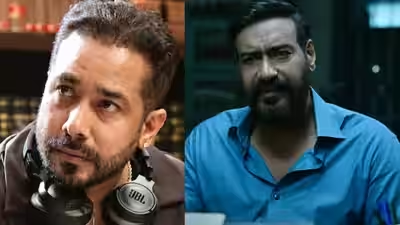











The Delhi High Court On Friday he accepted the verdict of actor Rajpal Naurang Yadav and his wife, Radha. Rajpal Yadavin several defamation cases linked to a financial dispute with Murli Projects Pvt. Ltd. In a powerful ruling, the Court rejected the 21 appeals filed by the family, and said that there was no reason to interfere with the decision of the High Court or the Sessions Court.Justice Swarana Kanta Sharma observed that the petitioners had repeatedly failed to fulfill their promises despite the Court’s leniency for several years.Looking at Rajpal Yadav’s conduct during the court’s judgment, the Supreme Court noted that the leading Bench had shown in the first instance that it did not want to interfere with its decision on the merits. However, his sentence was suspended after he expressed his desire to settle the matter amicably with the complainant.The judgment showed that Yadav repeatedly asked for more time to settle the money, and he himself and through his senior counsel, assured the court several times that he would repay the plaintiff. Believing these assurances, the Court adjourned the case repeatedly and continued to suspend his sentence.Despite receiving several opportunities over a long period of time, the actor failed to respect the Court’s decision. This led to him surrendering to the prison authorities. Although they were granted further relief after making some payments, the parties could not reach a final settlement.According to the Supreme Court, the situation changed when Rajpal Yadav told the Court that he “does not want to pay any money to the petitioner and would rather go to jail five times than pay back the money.”Responding to his statement, Mr. Justice Sharma observed that although the prosecution has the right to decide whether to arrest or repay the debt, this decision will not violate the law or prevent the promise made to the court.The court said according to ANI, “Needless to say that if a judge wants to choose the option of imprisonment instead of following the decision of the Court, that is his decision. The law is not a script that can be rewritten at the will of the player, and the legal obligations cannot be changed by any change of method… Courts judge on the basis of principles established by law and expect from each justice and respect for the judge.“The Supreme Court also rejected Yadav’s plea for release on probation under the Probation of Offenders Act, saying his conduct did not warrant the relief provided under the law.Separately, the Court rejected the couple’s request to agree to a delay of more than five years in filing an appeal challenging their decision. Justice Sharma found their explanation – that they believed the decision had already been challenged – was not supported by the record and lacked credibility.The court also held that the allegation that the delay was due to the wrong advice of the previous counsel cannot be taken as a sufficient reason to allow such a delay.Finding no justification, the Supreme Court denied all requests for a stay and, therefore, dismissed the complaint related to the crime, thus confirming the decision of the Court of Sessions on January 21, 2019.The court reviewed the order of the Sessions Court on May 29, 2024, which upheld the conviction in the criminal case while modifying the sentence. After considering the issues presented by the petitioners, the Supreme Court said that the conviction or sentence was not affected by any legal problem that caused them to be disturbed under its jurisdiction.While denying the relief, the Court observed that the petitioners had invested Rs.2.25 crore at the time the case was filed in the High Court, and the amount had already been released to the petitioner company.The controversy stems from the agreements made to finance the film ‘Ata Pata Lapata’. Court records show that Murli Projects Pvt. Ltd. had high stakes in Shree Naurang Godavari Entertainment Ltd., with Rajpal Yadav and his wife acting as guarantors.After repeated bounces and dishonor of several checks made after successive contracts, Murli Projects initiated seven complaints under Section 138 of the Negotiable Instruments Act. This led to the decision of the Delhi High Court which has been affirmed by the Delhi High Court.