










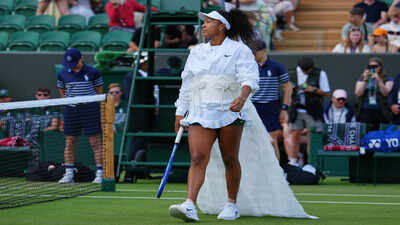
LONDON: Court No. 2 is located at one end of the All England Club, a few hundred meters from the players’ facilities. For Naomi Osaka, that just meant a longer runway. The four-time Grand Slam champion arrived on Wednesday in a reduced kimono-inspired look, accessorized with a obi which trailed behind her as she walked.On a day when her tennis showed every bit as much as her fashion, Osaka fed the former world No. 225 Anastasia Gasanova, firing eight aces in a 6-3, 6-2 win to reach the third round at Wimbledon. The 28-year-old Japanese will now bid for a place in the last 16 of the Championship when she takes on Australian Daria Kasatkina on Friday.After the launch, Osaka cleared the obi before shedding her floral applique bomber jacket to reveal an intricate tennis dress with a curved hem and micro-pleats. It was the latest chapter in her Wimbledon wardrobe after she arrived for her first-round match on Monday in an elaborate kimono embroidered with cranes and cherry blossoms.The thing about fashion is that while it can turn heads, it can’t move the scoreboard. And significantly, it creates expectations.In tennis, a bold statement can attract as much scrutiny as admiration, and players are judged as ready to dare to stand out as by what they wear.As Osaka walked past the crowd for her first match, she could hear the “wows” through her headphones.The 28-year-old may not be consumed by doubt, but she is not immune to the noise from the locker room and outside. Whatever story she chooses to tell through fashion is ultimately amplified by her tennis. Every walk is a fashion show until the first ball is struck. After that, the dress disappears and only the tennis remains.“I feel a little nervous,” he said. “Also, I want to get so used to that feeling that it doesn’t bother me anymore. I think the Australian Open was me throwing myself in head first with the umbrella and the hat and everything.”This willingness to step into the spotlight is what sets Osaka apart. American sixth seed Taylor Fritz, who arrived for his first-round match in a white blazer and trousers combination over his tennis clothes, admitted the weight a player carries when making such an entrance.Fritz said: “Seeing you in a full suit and you cut in the first round, it looks really stupid.”“I saw his fall. I thought it was pretty cool,” Osaka said of Fritz.Osaka, whose daughter Shai turns three on Thursday, is of Japanese and Haitian descent and grew up in Florida.On one of his first trips to Japan, on the 14thth the seed – an introvert by nature – was struck by Harajuku. A vibrant, pedestrian-only neighborhood in Tokyo that is synonymous with the capital’s youth culture.“In Harajuku I saw everyone expressing themselves through clothes. It was so fresh and colorful. It was me and I used this in my fashion experimentation,” he said. A couple of summers ago in New York, Harajuku influencers shaped their elaborate US Open outfits. In January at Melbourne Park, she took to the court wearing a wide-brimmed hat under a blusher veil and carrying a white parasol, turning the walk into a catwalk in a way few athletes before her had attempted.The walk to the court can take a minute or more, but for Osaka, it’s where the risk, the identity and the spectacle begin.