


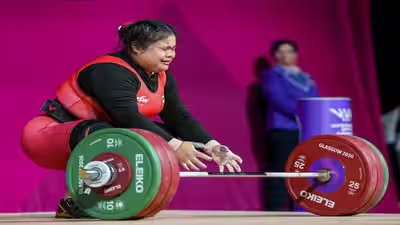


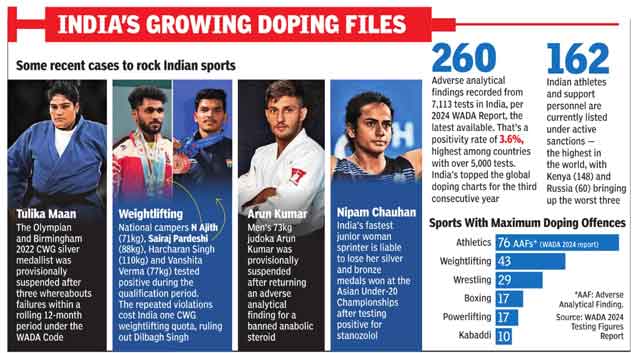
Shortly before the start of the Commonwealth Games (CWG) in Glasgow, a stunning doping scandal rocked the weightlifting contingent. Four national wrestlers – N Ajith (71kg), Sairaj Pardeshi (88kg), Harcharan Singh (110kg) and Vanshita Verma (77kg) – tested positive for banned substances during the qualification period, forcing them out of the games. The fallout extended beyond individual suspension. Under CWG regulations, repeated anti-doping rule violations (ADRV) led to India losing a weight quota, denying Dilbagh Singh a place in the team despite being selected on merit.There was more to follow. 73kg male judoka Arun Kumar, winner of the Taipei Asian Open gold medal last year, has been provisionally suspended after testing positive for a banned anabolic steroid. Days later came perhaps the biggest setback when Olympian and Birmingham CWG silver medalist Tulika Maan (+78kg) was provisionally suspended after accumulating three failures at the venue in a 12-month period.It wasn’t just the potential loss of medals. Six high-profile anti-doping encounters in two disciplines took the conversation away from the podium to the country’s shameful relationship with doping. Yet, at a time when India is the worst doping offender in sports in the world, with its credibility at its lowest, few want to openly discuss the elephant in the room.But looking away doesn’t make the problem go away. It is also at a time when Ahmedabad is preparing to host the next Commonwealth Games in 2030 and the country has formally declared its intention to host the 2036 Olympics.
A disturbing trend
According to the World Anti-Doping Agency’s (WADA) Testing Figures 2024 Report, published in December 2025, India recorded 260 adverse analytical results (AAF) from 7,113 samples collected during the year – a positivity rate of 3.6%. Among countries that conduct more than 5,000 tests a year, India recorded the highest positivity rate in the world for the third consecutive year.The comparison with other sports powers is sobering. France reported 91 violations from 11,744 tests, Russia 76 from 10,514 samples, while China found only 43 positives despite collecting more than 24,000 samples. The United States recorded a positivity rate of only 1.1% after conducting more than 6,500 tests.The challenge is visible in athletics. The Athletics Integrity Unit (AIU) currently lists India as the country with the highest number of active sanctions in the world. As many as 162 Indian athletes and support staff are serving bans under the AIU framework, ahead of Kenya (148) and Russia (60).
New substances. Old model
The list of substances repeatedly emerging in Indian cases reflects a worrying trend. Stanozolol, a synthetic anabolic steroid banned under WADA’s S1 category, continues to dominate anti-doping reports despite years of awareness campaigns. The drug is designed to promote muscle growth, accelerate recovery and reduce body fat.Recent athletes who have tested positive for stanozolol include former world youth boxing champion Vinka, Asian indoor rowing championships winner Gursewak Singh, junior sprint sensation Nipam Chauhan, wrestler Shubham and kabaddi player Akash Nathu Disale.Perhaps the most damaging among recent cases has been Nipam. India’s fastest junior sprinter now faces losing the silver and bronze medals she won at the Asian Under-20 championships in Hong Kong after she tested positive for stanozolol.
Beyond punishment
The government has begun to shift its focus beyond athletes to the wider ecosystem that enables doping. At the inaugural WADA Global Anti-Doping Intelligence and Investigations Network (GAIIN) conference held in New Delhi recently, Sports Minister Mansukh Mandaviya outlined what could become the biggest overhaul of India’s anti-doping policy.“Doping today is no longer an individual act, but an organized multinational enterprise,” he said, adding that the proposed changes to the National Anti-Doping Amendment Act 2025 seek to bring coaches, doctors, suppliers and traffickers under criminal liability.The draft provisions provide for prison sentences ranging from five to 10 years, together with financial penalties for those who participate in the administration or trafficking of prohibited substances. Athletes guilty only of anti-doping rule violations will continue to be dealt with under existing sports regulations.Mandaviya stressed that India’s ambitions extend beyond medals. “India is committed not only to sporting excellence, but to maintaining the highest standards of integrity,” he said, adding that awareness, education and technology will remain central pillars of the nation’s clean sports program.The government simultaneously expanded testing, nearly doubling annual samples from about 4,000 in 2019 to nearly 8,000 last year. “Our testing program has developed significantly in recent years, complemented by a strategic shift towards risk-based and effectiveness-based approaches. However, as we recognize, testing alone is no longer enough, and integration, intelligence and education must be at the heart of our anti-doping framework,” said NADA’s general manager, Anant Kumar.
Athletes drive the message
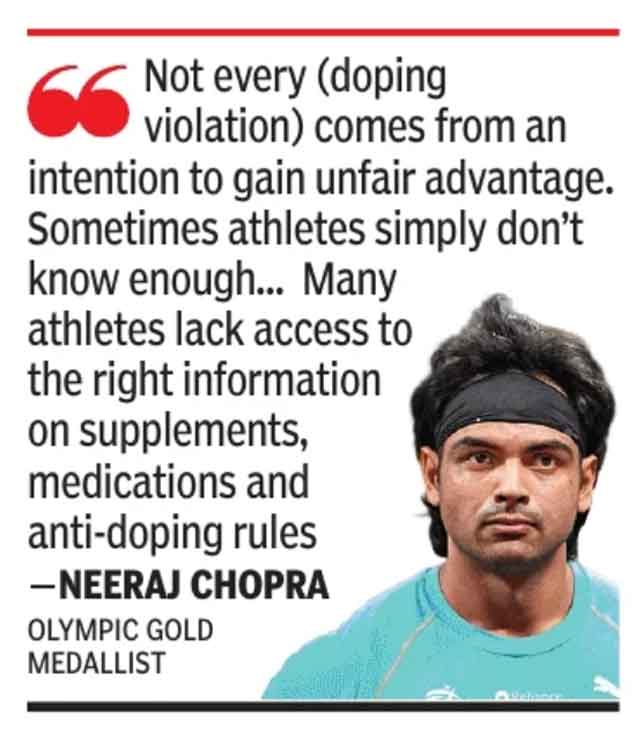
Olympic and world champion Neeraj Chopra has now become one of the loudest voices advocating for athlete education. After launching the ‘Clean Sport’ initiative with the Indian Olympic Association (IOA) through the Neeraj Chopra Foundation (NCF), Chopra said that many athletes violate anti-doping rules because they simply lack reliable guidance.“Every doping violation is a concern because it impacts the athlete and the sport. But not every case comes from an intention to gain an unfair advantage. Sometimes athletes don’t know enough about what they are consuming or who to trust for advice,” Chopra told TOI.Explaining his decision to champion the campaign despite a packed schedule, Chopra added: “Many athletes lack access to the right information about supplements, medications and anti-doping rules. Years of hard work can be at risk for a small mistake.”
Beyond black and white
Not everyone believes that the current anti-doping framework is beyond criticism. Sports medicine expert Dr PSM Chandran argues that while cheating cannot be ruled out, the current system also raises scientific and ethical concerns.“Doping can really be harmful to sport. Fair play matters, and cheating cannot be condoned. In any case, doping control in its current format is also harmful to athletes, since it rigidly adheres to the WADA Code, while often disregarding evidence-based medicine, proportionality and natural justice,” he said.He questioned whether each positive test necessarily translates into a measurable competitive advantage and called on authorities to publish performance analyzes of athletes before and after alleged periods of doping.“Without such evidence, the claim that banned substances universally enhance performance remains belief, not science,” said Chandran, president of the Indian Federation of Sports Medicine (IFSM). Their views are likely to divide opinion, but they also underline the complexity of anti-doping policy, where science, ethics and sporting integrity often intersect.
Education, not fear
National gymnastics coach Manoj Rana believes that India’s response must start much earlier. “Indian sport has seen remarkable progress on the global stage, but the increasing number of doping violations continues to undermine these achievements. The answer is not just stricter punishments, but stronger prevention,” said Rana.He points to intense pressure on athletes to win medals, secure government jobs and maintain financial support, often without access to qualified nutritionists, sports scientists or evidence-based medical guidance.The problem is more complicated by changing training models. Many elite Indian athletes train overseas, particularly in Eastern Europe and the high-altitude centers of Russia, Turkey and Georgia. While foreign exposure has improved performances, investigators also believe some athletes are operating outside India’s national testing ecosystem under uncertified local support staff or little-known foreign coaches. Indian authorities previously terminated engagement with some Eastern European coaches after sudden spikes in positive tests among elite campers.
Contradictions to worry
Ironically, at a time when India is facing global scrutiny over doping, financial support for its anti-doping institutions has dwindled.The Union Budget has reduced the allocations for the NADA and the National Dope Testing Laboratory (NDTL). NADA’s allocation fell from Rs 24.30 crore to Rs 20.30 crore, while the revised allocation for NDTL fell from Rs 28.55 crore to Rs 23 crore, with the lab’s own budget reduced to Rs 5.55 crore.The cuts inevitably raise questions about whether India’s anti-doping agencies can continue to expand testing, intelligence gathering and education precisely when they are most needed.
The real test
For India, therefore, Glasgow represents much more than just another CWG. It is a reminder that the hosting of the CWG in Ahmedabad, the security of the 2036 Olympics or the staging of the Asian Games in 2038 will depend not only on world-class stadiums or impressive medals, but on the credibility of the country’s sports ecosystem.India has already shown that it possesses the ambition, infrastructure and organizational capacity to emerge as a global sports destination. But as the list of errant athletes continues to grow rapidly, the biggest challenge is to provide a robust culture of clean sport. The danger of letting things drift cannot be understated. Let’s not forget that Russia was banned from international sports due to doping offences. A strict law is welcome. But the authorities should also take a holistic and long-term view of the threat and find ways to eradicate it completely.