









Every year, India sells more tractors than any other country in the world. However, for decades, almost every machine relied on diesel, leaving farmers with rising fuel costs and maintenance bills. While global car companies focus on electric passenger cars, one Indian engineer believes the real opportunity lies elsewhere – on the country’s farms.That engineer is Anoop Srikantaswamy, an automotive professional who spent more than a decade working with global giants such as Toyota, Volvo, Accenture and Ola before embarking on the entrepreneurial journey. Rather than building another electric vehicle startup, he chose one of the toughest engineering challenges in India’s transportation sector: developing an electric tractor designed specifically for Indian agricultural conditions.Today, his Bengaluru-based startup Moonrider is attracting investors, garnering massive customer commitments, and is trying to redefine agricultural mechanization through clean technology.His experience shows that sometimes the biggest innovations come not from crowded industries but from solving problems that others ignore.
From engineering classroom to world’s leading automotive company
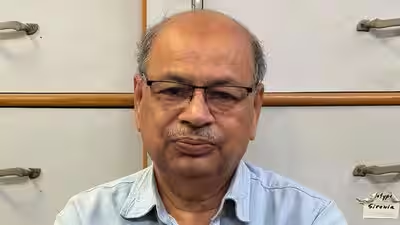
Anoop earned a bachelor’s degree in mechanical engineering from Visvesvaraya Technological University and then strengthened his leadership skills through Cornell University’s executive general management program.He began his career at Toyota Kirloskar, where he worked on new product development and learned the processes behind one of the world’s most respected automakers.He later worked for the Volvo Group for more than nine years, holding various engineering leadership positions while working on global vehicle development projects. During this time, he gained hands-on experience designing complex automotive systems, leading engineering teams, and understanding what it takes to build world-class automotive platforms.After Volvo, he briefly led electric vehicle consulting projects at Accenture before joining Ola as director of product development. At that time, he had worked for more than 12 years at some of the world’s largest automotive organizations.But there was one question that kept bothering him.If India is the largest tractor market in the world, why is no one building a world-class electric tractor specifically for Indian farmers?
Leaving a successful corporate career to solve rural problems
In 2023, Anup decided to leave the comfort of corporate leadership and start from scratch.He founded Moonrider in Bengaluru with former Volvo colleague Ravi Kulkarni with a simple but ambitious vision: to make farming more profitable, sustainable and technologically advanced.Rather than adapting overseas tractor designs, the founders decided to build an entirely new platform for Indian agriculture from scratch.Their goal is not just to replace diesel with batteries.They hope the tractors will reduce operating costs, increase efficiency and prepare them for the future of Indian agriculture.
Designing electric tractors for Indian farms
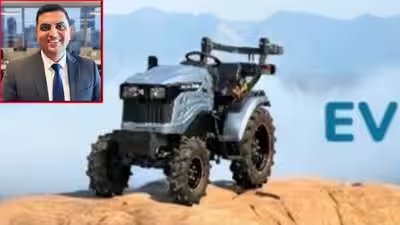
Moonrider’s tractors are available in a variety of power categories, including 27 hp, 50 hp and 75 hp models, to meet different farming needs.The company has introduced several engineering innovations that differentiate its products from traditional electric tractors.These include what Moonrider describes as the world’s first oil-cooled battery thermal management system for tractors, helping the batteries operate reliably even in harsh agricultural conditions.The tractors also feature internal battery packs, active cell balancing technology, over-the-air software updates, mobile app integration and support for future autonomous and platooning capabilities.Perhaps the most notable milestones came in the company’s early stages.The engineering team reportedly completed development from concept to working prototype in less than 40 days, an unusually fast time in the automotive industry. The technology has also been patented in India.
Investor confidence strong, plans to deliver thousands
Building heavy-duty electric vehicles requires a lot of money, and Moonrider has already attracted significant interest from investors.The startup has raised approximately $8.38 million from investors including pi Ventures and Micelio.It has also signed a memorandum of understanding (MoU) to deliver around 6,000 tractors over the next three years, providing early validation of its business model.Customer deliveries have begun, marking the transition from engineering innovation to commercial deployment.For a startup operating in the most capital-intensive manufacturing segment, these milestones signal growing confidence in India’s agriculture electrification story.
Why this journey is important for engineering students
Many engineering graduates dream of joining a multinational company and Anoop has made it possible by working with a globally recognized automobile manufacturer.However, after accumulating years of international experience, he chose to leave a stable corporate career to solve India-specific challenges.Rather than compete in the already crowded electric vehicle market, he’s focused on an industry that directly impacts millions of farmers and the nation’s food security.His journey highlights an important lesson for students: world-changing innovation doesn’t always mean inventing something entirely new. Sometimes that means recognizing a big problem that everyone else ignores and applying years of technical expertise to solve it.As India accelerates its transition to clean transportation and sustainable agriculture, entrepreneurs like Anoop Srikantaswamy are proving that the next wave of innovation may not start on city roads but in the country’s fields.Disclaimer: This article is based on public information, company announcements, professional profiles and interviews shared by Anoop Srikantaswamy and Moonrider. Financial data, product specifications and business milestones are based on publicly available reports at the time of writing and are provided for informational purposes only.